
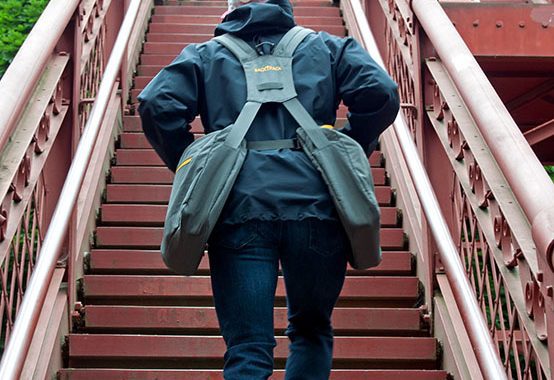
Load Balance, Posture, and the Long-Term Cost of Compensating
If a carry bag makes you lean forward, twist, hike one shoulder, or brace your neck, that’s not a comfort issue. It’s a load-path issue.
When weight sits off the body’s vertical axis, the body compensates to keep balance. That compensation is often subtle at first. Repeated daily, it can become a long-term pattern: flare cycles, fatigue, and reduced function. During the growth period this can affect bone growth and development.
Explore the vertical-axis loading concept. Vertical-axis loading means placing weight along the body’s natural centerline to reduce compensatory strain.
The disability lens (how people judge “good” carry gear)
People living with scoliosis, chronic pain, mobility limits, or post-surgical restrictions often judge carry systems differently than lifestyle reviews do. The questions become:
- Will this trigger a flare that lasts days (or longer)?
- Does this slowly degrade my shoulders, back and neck over years?
- Can I access essentials without twisting, reaching, or unloading everything?
- Can I direct a caregiver to what I need, fast and reliably?
Wheelchair bag testing often emphasizes compartment clarity and reach-while-seated as functional requirements, not preferences. BackTpack is effective on motorized wheelchairs, where it can be set up with one bag on the back and another on the side under the controls—making items easily accessible for both the user and caregiver—though it may not be as compatible with a properly fitted standard wheelchair.
What off-axis carry does over time (simple mechanics)
Off-axis carry shifts center of gravity. To avoid falling, your body adjusts posture and muscle tension to counter-torque the load. Over time, those temporary adjustments can become your default.
Research reviews link heavy and improperly carried loads with postural change and musculoskeletal strain risk, especially when posture changes are sustained over time, and especially during the growth period, i.e, school age.
What changes when the load is brought back toward the vertical axis
A balanced carry approach aims to apply load on the body’s vertical axis instead of pulling backward (or to one side). The claimed benefit is straightforward: no posture distortion, less effort spent “fighting” the load, and upright alignment during movement.
Real-world outcomes (user-reported, not medical promises)
Some users report rapid improvement in back and neck strain in the context of heavy daily carry. Others describe the long-horizon benefit as “less aggravating” for alignment-sensitive conditions.
Who BackTpack is most useful for
This approach tends to matter most when you:
- Carry meaningful weight daily (work, school, medical gear)
- Need predictable access while seated
- Are managing pain, fatigue, or alignment constraints where compensation has real downstream costs
Top Rated Products
-
 BackTpack Premium 4.1
Rated 5.00 out of 5$125.00
BackTpack Premium 4.1
Rated 5.00 out of 5$125.00 -
 BackTpack Basic 3.1
Rated 5.00 out of 5$95.00
BackTpack Basic 3.1
Rated 5.00 out of 5$95.00 -
 BackTpack Mini
Rated 5.00 out of 5$37.00
BackTpack Mini
Rated 5.00 out of 5$37.00
Have Questions About How BackTpack Works for You?
Marilyn is a Physical Therapist with over 50 years of experience and is happy to help you find the best BackTpack for your needs.
Recent Posts
- Backpack Pain, Posture & Disability | Practical FAQ on Carry Systems
- Why This Carry System Exists | Load Balance, Posture & Long-Term Impact
- Uneven Loads and Posture: Why Lopsided Carry Causes Long-Term Strain
- Why Backpacks Cause Shoulder & Neck Pain (And When It Becomes Chronic)
- School Backpacks and COVID